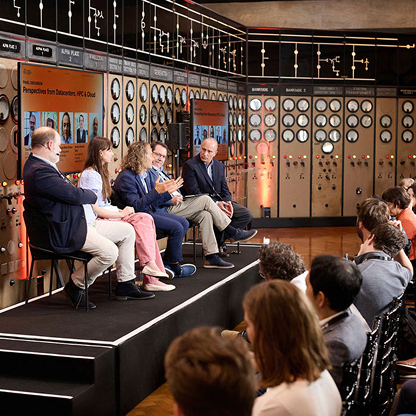
On the day
The full programme

Session 1: Imagining New Worlds and scene setting
Carmen Palacios-Berraquero, CEO of Nu Quantum, opens the QDA Forum 2026 — welcoming the alliance, framing the mission, and setting the agenda for the day ahead.
Dame Wendy Hall reflects on how classical computing scaled from research machines to global infrastructure — and what that journey can teach us about building the quantum datacenters of tomorrow.
Science journalist Karmela Padavic-Callaghan offers an outside-in view of the field: how quantum computing's story is being told, where the hype outruns the science, and what genuine progress looks like from the press box.
Session 2: Where we are today: QPU-HPC deployments
In July 2026 the LUMI AI Factory chose IQM Quantum Computers to deliver LUMI-IQ. This advanced quantum computer will have a QPU with 150 high-quality qubits, followed by a series of upgrades delivered in multiple phases. The system is scheduled for deployment in autumn 2027 at CSC’s new data center in Kajaani.
Olli Mukkula (CSC) shares insights on HPC environment, in collaboration with Eric Mansfield (IQM).
Alexei Bylinskii on QuEra's experience deploying neutral-atom quantum computers into Japan's high-performance computing ecosystem — and what it takes to run quantum hardware far from home.
How OQC and Equinix brought quantum computing into a commercial colocation datacenter — the engineering, operations and from running QPUs alongside classical infrastructure.
The session's speakers compare notes on today's QPU–HPC deployments. Moderated by Dr. Jonathan Burnett, Deputy Director for Research at the NQCC.
A short update on the UK's national quantum ambition and the role of public programmes in accelerating the path to fault-tolerance.

Session 3: Architectures of tomorrow: Fault Tolerant Scale-out
Michael Hush of Q-CTRL on heterogeneous architectures — combining different qubit modalities and classical resources into one coherent, controllable system.
Ben Bloom of Atom Computing on modular architecture for neutral-atom machines and the road to scaling qubit counts beyond a single system.
IBM on its modular architecture programme — linking processors into larger systems and the engineering milestones on the road to fault-tolerance.
The session's speakers debate the architectures of tomorrow — where modularity is essential, where it isn't, and what a datacenter-scale quantum computer will really look like.

Session 4: Building the ecosystem and infrastructure
Austin S. Lin, ex-Google, on what quantum can learn from hyperscale supply chains — and why standards work now will determine how fast the industry can build later.
Olivier is a an author, trainer, academic and advisor on quantum technologies working with businesses and public services. Co-founder of the Quantum Energy Initiative launched in 2022, he will be discussing on the power and cooling realities of quantum datacenters — what today's facilities can support and where infrastructure must evolve.
Rob Stockill, CTO of QphoX, provides perspective on what will be necessary to build the ecosystem and infrastructure.
Seyon Sivarajah of Quantinuum on what's still missing in the quantum software stack — from compilation and error correction to the interfaces datacenter operators will actually use.
Dr Cameron Barker, Infleqtion's UK Software Lead, on Superstaq and the middleware layer — making heterogeneous quantum hardware usable through one software interface.
An investor's-eye view of the ecosystem discussion: what needs to be true — technically and commercially — for datacenter-scale quantum to attract the capital it requires. Moderated by Richard Moulds.

Closing Sessions: Trends in Quantum Datacenters
Andy Grant of NVIDIA on the role of accelerated computing in the quantum stack — hybrid quantum–GPU systems and the compute supply questions the industry needs to answer.
Luca Della Chiesa of Cisco on scaling quantum data centers, and lessons to be learned from classical infrastructure.
Dr Anna Tatarczak of Coherent on optical interconnects built for AI datacenters — and what that photonics revolution offers the quantum scale-out roadmap.
Closing remarks from Carmen Palacios-Berraquero: what the alliance takes forward from today, and the road to QDA Forum 2027.



Accelerating the timeline to quantum utility for good.